In this section we use continued fractions ([2]) for expansion of rational numbers. If  ,
,  ,
,  , are integer nunbers with
  for every
  then
then ![\displaystyle [x_0;x_1,x_2,\ldots,x_n]\in\mathbb{Q},\quad\forall n\geq 0.](https://s0.wp.com/latex.php?latex=%5Cdisplaystyle+%5Bx_0%3Bx_1%2Cx_2%2C%5Cldots%2Cx_n%5D%5Cin%5Cmathbb%7BQ%7D%2C%5Cquad%5Cforall+n%5Cgeq+0.&bg=ffffff&fg=000000&s=0&c=20201002)
Conversly, we have the theorem
Theorem 1. Let  and
and  be coprime integers with
  . Then there are non negative integer
  and integers
  ,
,  , ,
, ,  such that
(1)  for every
  .
.
(2) ![\displaystyle r/s=[a_0;a_1,a_2,\ldots,a_n]](https://s0.wp.com/latex.php?latex=%5Cdisplaystyle+r%2Fs%3D%5Ba_0%3Ba_1%2Ca_2%2C%5Cldots%2Ca_n%5D&bg=ffffff&fg=000000&s=0&c=20201002) .
.
Proof. Let us proceed by induction on . The case  is trivial. Now suppose that the assertion is true for all positive integers up to
  (
( ). Because
  and , we have
  . Hence by the Division Algorithm ([1]), there are integers
  and
and  such that

By the hypothesis of the induction, there are integers  , ,
, ,  , ,
, ,  such that
![\displaystyle \frac{s}{b}=[a_1;a_2,a_3,\ldots,a_m].\quad\quad (2)](https://s0.wp.com/latex.php?latex=%5Cdisplaystyle+%5Cfrac%7Bs%7D%7Bb%7D%3D%5Ba_1%3Ba_2%2Ca_3%2C%5Cldots%2Ca_m%5D.%5Cquad%5Cquad+%282%29&bg=ffffff&fg=000000&s=0&c=20201002)
Because  , we have
  . From (1) and (2) we have
![\displaystyle \frac{r}{s}=a+\frac{1}{s/b}=a+\frac{1}{[a_1;a_2,a_3,\ldots,a_m]}=[a;a_1,a_2,\ldots,a_m],](https://s0.wp.com/latex.php?latex=%5Cdisplaystyle+%5Cfrac%7Br%7D%7Bs%7D%3Da%2B%5Cfrac%7B1%7D%7Bs%2Fb%7D%3Da%2B%5Cfrac%7B1%7D%7B%5Ba_1%3Ba_2%2Ca_3%2C%5Cldots%2Ca_m%5D%7D%3D%5Ba%3Ba_1%2Ca_2%2C%5Cldots%2Ca_m%5D%2C&bg=ffffff&fg=000000&s=0&c=20201002) completing the induction step.
completing the induction step. 
The equality in the theorem is called an expansion of  into a finite continued fraction. In that expansion we will call
 ![\displaystyle [a_0;a_1,a_2,\ldots,a_i]](https://s0.wp.com/latex.php?latex=%5Cdisplaystyle+%5Ba_0%3Ba_1%2Ca_2%2C%5Cldots%2Ca_i%5D&bg=ffffff&fg=000000&s=0&c=20201002) is the
is the  th convergent of the continued fraction, or th convergent of .
Example 1. Find an expansion of  into a finite continued fraction.
Solution. By the Division Algorithm, we have
 and
and
 and
and  . Therefore
 ![\displaystyle 43/5=[8;1,1,2]](https://s0.wp.com/latex.php?latex=%5Cdisplaystyle+43%2F5%3D%5B8%3B1%2C1%2C2%5D&bg=ffffff&fg=000000&s=0&c=20201002) .
.
The theorem says that for every rational number has an expansion into a finite continued fraction. But this expansion is not unique.
Example 2. ![\displaystyle 13/5=[2;1,1,2]=[2;1,1,1,1]](https://s0.wp.com/latex.php?latex=%5Cdisplaystyle+13%2F5%3D%5B2%3B1%2C1%2C2%5D%3D%5B2%3B1%2C1%2C1%2C1%5D&bg=ffffff&fg=000000&s=0&c=20201002) .
.
Theorem 2. Let  be an integer number. Then has exactly two expansions into a finite continued fraction.
Proof. By the theorem 1, we can write
![\displaystyle \alpha=[a_0;a_1,a_2,\ldots,a_n],](https://s0.wp.com/latex.php?latex=%5Cdisplaystyle+%5Calpha%3D%5Ba_0%3Ba_1%2Ca_2%2C%5Cldots%2Ca_n%5D%2C&bg=ffffff&fg=000000&s=0&c=20201002)
where  ,
,  ,
,  ,
,  are integers such that
  for every
  . If
. If  then
then  and
and ![\displaystyle \alpha=[\alpha]](https://s0.wp.com/latex.php?latex=%5Cdisplaystyle+%5Calpha%3D%5B%5Calpha%5D&bg=ffffff&fg=000000&s=0&c=20201002) is an expansion of . If
is an expansion of . If  then
then  , hence
  is an integer, so
  . Therefore
 ![\displaystyle \alpha=[\alpha-1;1]](https://s0.wp.com/latex.php?latex=%5Cdisplaystyle+%5Calpha%3D%5B%5Calpha-1%3B1%5D&bg=ffffff&fg=000000&s=0&c=20201002) is an expansion of .
is an expansion of .
Now assume that  . We have
![\displaystyle \alpha-a_0=\frac{1}{[a_1;a_2,\ldots,a_n]}](https://s0.wp.com/latex.php?latex=%5Cdisplaystyle+%5Calpha-a_0%3D%5Cfrac%7B1%7D%7B%5Ba_1%3Ba_2%2C%5Cldots%2Ca_n%5D%7D&bg=ffffff&fg=000000&s=0&c=20201002)
is an integer number and ![\displaystyle [a_1;a_2,\ldots,a_n]>0](https://s0.wp.com/latex.php?latex=%5Cdisplaystyle+%5Ba_1%3Ba_2%2C%5Cldots%2Ca_n%5D%3E0&bg=ffffff&fg=000000&s=0&c=20201002) , hence
, hence ![\displaystyle [a_1;a_2,\ldots,a_n]\leq 1](https://s0.wp.com/latex.php?latex=%5Cdisplaystyle+%5Ba_1%3Ba_2%2C%5Cldots%2Ca_n%5D%5Cleq+1&bg=ffffff&fg=000000&s=0&c=20201002) . This claim is false because and
. This claim is false because and  for every .
Theorem 3. Let be a rational number but not an integer. Then has exactly two expansions into a finite continued fraction.
Proof. Assume that  , where and are coprime integers. We prove by induction on that has exactly two expansions into a finite continued fraction
![\displaystyle \alpha=[a_0;a_1,\ldots,a_n]=[a_0;a_1,\ldots,a_n-1,1],](https://s0.wp.com/latex.php?latex=%5Cdisplaystyle+%5Calpha%3D%5Ba_0%3Ba_1%2C%5Cldots%2Ca_n%5D%3D%5Ba_0%3Ba_1%2C%5Cldots%2Ca_n-1%2C1%5D%2C&bg=ffffff&fg=000000&s=0&c=20201002)
where  . If
. If  , because there is an integer
  such that
  . By the theorem 1, we can write
![\displaystyle \alpha=k+\frac{1}{2}=[a_0;a_1,a_2,\ldots,a_n],](https://s0.wp.com/latex.php?latex=%5Cdisplaystyle+%5Calpha%3Dk%2B%5Cfrac%7B1%7D%7B2%7D%3D%5Ba_0%3Ba_1%2Ca_2%2C%5Cldots%2Ca_n%5D%2C&bg=ffffff&fg=000000&s=0&c=20201002)
where , , , are integers such that for every . We have  and
and  , hence
 ![\displaystyle 2=[a_1;a_2,\ldots,a_n]](https://s0.wp.com/latex.php?latex=%5Cdisplaystyle+2%3D%5Ba_1%3Ba_2%2C%5Cldots%2Ca_n%5D&bg=ffffff&fg=000000&s=0&c=20201002) . By the theorem 2, we have
. By the theorem 2, we have  has exactly two expansions into a finite continued fraction, those are
 ![2=[2]](https://s0.wp.com/latex.php?latex=2%3D%5B2%5D&bg=ffffff&fg=000000&s=0&c=20201002) and
and ![2=[1;1]](https://s0.wp.com/latex.php?latex=2%3D%5B1%3B1%5D&bg=ffffff&fg=000000&s=0&c=20201002) , therefore
, therefore  has exactly two expansions
 ![\displaystyle \alpha=[k;2]=[k;1,1],](https://s0.wp.com/latex.php?latex=%5Cdisplaystyle+%5Calpha%3D%5Bk%3B2%5D%3D%5Bk%3B1%2C1%5D%2C&bg=ffffff&fg=000000&s=0&c=20201002) hence the claim is true for . Now suppose that the claim is true for
hence the claim is true for . Now suppose that the claim is true for  ,
,  , , (
, , ( ). By the theorem 1, we can write
where , , , are integers such that for every . We have and ![a_0=[\alpha]](https://s0.wp.com/latex.php?latex=a_0%3D%5B%5Calpha%5D&bg=ffffff&fg=000000&s=0&c=20201002) (integer part of ), hence
(integer part of ), hence ![\displaystyle \frac{1}{\alpha-[\alpha]}=[a_1;a_2,\ldots,a_n].](https://s0.wp.com/latex.php?latex=%5Cdisplaystyle+%5Cfrac%7B1%7D%7B%5Calpha-%5B%5Calpha%5D%7D%3D%5Ba_1%3Ba_2%2C%5Cldots%2Ca_n%5D.&bg=ffffff&fg=000000&s=0&c=20201002) By the Division Algorithm, there is an integer such that
By the Division Algorithm, there is an integer such that ![\displaystyle r=s[\alpha]+a](https://s0.wp.com/latex.php?latex=%5Cdisplaystyle+r%3Ds%5B%5Calpha%5D%2Ba&bg=ffffff&fg=000000&s=0&c=20201002) and
and  , then
![\displaystyle \frac{s}{a}=[a_1;a_2,\ldots,a_n].](https://s0.wp.com/latex.php?latex=%5Cdisplaystyle+%5Cfrac%7Bs%7D%7Ba%7D%3D%5Ba_1%3Ba_2%2C%5Cldots%2Ca_n%5D.&bg=ffffff&fg=000000&s=0&c=20201002)
If  then
then  and by the theorem 2, we have
  has exactly two expansions are
 ![s/a=[a_1]](https://s0.wp.com/latex.php?latex=s%2Fa%3D%5Ba_1%5D&bg=ffffff&fg=000000&s=0&c=20201002) and
and ![\displaystyle s/a=[a_1-1;1]](https://s0.wp.com/latex.php?latex=%5Cdisplaystyle+s%2Fa%3D%5Ba_1-1%3B1%5D&bg=ffffff&fg=000000&s=0&c=20201002) . If
. If  then by the hypothesis of the induction (note that and are coprime integers),
  has exactly two expansions are
![\displaystyle \frac{s}{a}=[a_1;b_2,\ldots,b_n]=[a_1;b_2,\ldots,b_n-1,1],](https://s0.wp.com/latex.php?latex=%5Cdisplaystyle+%5Cfrac%7Bs%7D%7Ba%7D%3D%5Ba_1%3Bb_2%2C%5Cldots%2Cb_n%5D%3D%5Ba_1%3Bb_2%2C%5Cldots%2Cb_n-1%2C1%5D%2C&bg=ffffff&fg=000000&s=0&c=20201002)
where  . Therefore has exactly two expansions, and the claim is true for .
References
[1] https://nttuan.org/2020/01/14/divisibility/
[2] https://nttuan.org/2008/11/14/continued-fraction-expansion-of-rational-numbers/


![\displaystyle [x_0;x_1,x_2,\ldots]](https://s0.wp.com/latex.php?latex=%5Cdisplaystyle+%5Bx_0%3Bx_1%2Cx_2%2C%5Cldots%5D&bg=ffffff&fg=000000&s=0&c=20201002)


![\displaystyle \alpha =[a_0;a_1,a_2,\ldots]](https://s0.wp.com/latex.php?latex=%5Cdisplaystyle+%5Calpha+%3D%5Ba_0%3Ba_1%2Ca_2%2C%5Cldots%5D&bg=ffffff&fg=000000&s=0&c=20201002)
![\displaystyle [x]](https://s0.wp.com/latex.php?latex=%5Cdisplaystyle+%5Bx%5D&bg=ffffff&fg=000000&s=0&c=20201002)

![\displaystyle [\alpha]<\alpha<[\alpha]+1](https://s0.wp.com/latex.php?latex=%5Cdisplaystyle+%5B%5Calpha%5D%3C%5Calpha%3C%5B%5Calpha%5D%2B1&bg=ffffff&fg=000000&s=0&c=20201002)

![\displaystyle \alpha=[\alpha]+\frac{1}{u_1}.](https://s0.wp.com/latex.php?latex=%5Cdisplaystyle+%5Calpha%3D%5B%5Calpha%5D%2B%5Cfrac%7B1%7D%7Bu_1%7D.&bg=ffffff&fg=000000&s=0&c=20201002)
![\displaystyle [\alpha]](https://s0.wp.com/latex.php?latex=%5Cdisplaystyle+%5B%5Calpha%5D&bg=ffffff&fg=000000&s=0&c=20201002)


![\displaystyle u_1=[u_1]+\frac{1}{u_2},](https://s0.wp.com/latex.php?latex=%5Cdisplaystyle+u_1%3D%5Bu_1%5D%2B%5Cfrac%7B1%7D%7Bu_2%7D%2C&bg=ffffff&fg=000000&s=0&c=20201002)


![\displaystyle u_k=[u_k]+\frac{1}{u_{k+1}},\quad\forall k\geq 0.](https://s0.wp.com/latex.php?latex=%5Cdisplaystyle+u_k%3D%5Bu_k%5D%2B%5Cfrac%7B1%7D%7Bu_%7Bk%2B1%7D%7D%2C%5Cquad%5Cforall+k%5Cgeq+0.&bg=ffffff&fg=000000&s=0&c=20201002)
![\displaystyle \alpha=[[u_0];[u_1],[u_2],\ldots]](https://s0.wp.com/latex.php?latex=%5Cdisplaystyle+%5Calpha%3D%5B%5Bu_0%5D%3B%5Bu_1%5D%2C%5Bu_2%5D%2C%5Cldots%5D&bg=ffffff&fg=000000&s=0&c=20201002)

![\displaystyle \alpha=[[u_0];[u_1],\ldots, [u_k],u_{k+1}].](https://s0.wp.com/latex.php?latex=%5Cdisplaystyle+%5Calpha%3D%5B%5Bu_0%5D%3B%5Bu_1%5D%2C%5Cldots%2C+%5Bu_k%5D%2Cu_%7Bk%2B1%7D%5D.&bg=ffffff&fg=000000&s=0&c=20201002)


![\displaystyle \alpha =[a_0;a_1,a_2,\ldots]=[b_0;b_1,b_2,\ldots],](https://s0.wp.com/latex.php?latex=%5Cdisplaystyle+%5Calpha+%3D%5Ba_0%3Ba_1%2Ca_2%2C%5Cldots%5D%3D%5Bb_0%3Bb_1%2Cb_2%2C%5Cldots%5D%2C&bg=ffffff&fg=000000&s=0&c=20201002)


![\displaystyle [a_0;a_1,a_2,\ldots,a_{n}]=a_0+\frac{1}{[a_1;a_2,\ldots,a_n]},\quad\forall n\geq 0,](https://s0.wp.com/latex.php?latex=%5Cdisplaystyle+%5Ba_0%3Ba_1%2Ca_2%2C%5Cldots%2Ca_%7Bn%7D%5D%3Da_0%2B%5Cfrac%7B1%7D%7B%5Ba_1%3Ba_2%2C%5Cldots%2Ca_n%5D%7D%2C%5Cquad%5Cforall+n%5Cgeq+0%2C&bg=ffffff&fg=000000&s=0&c=20201002)
![\displaystyle [a_0;a_1,a_2,\ldots]=a_0+\frac{1}{[a_1;a_2,\ldots]}.](https://s0.wp.com/latex.php?latex=%5Cdisplaystyle+%5Ba_0%3Ba_1%2Ca_2%2C%5Cldots%5D%3Da_0%2B%5Cfrac%7B1%7D%7B%5Ba_1%3Ba_2%2C%5Cldots%5D%7D.&bg=ffffff&fg=000000&s=0&c=20201002)
![\displaystyle a_0=b_0=[\alpha]](https://s0.wp.com/latex.php?latex=%5Cdisplaystyle+a_0%3Db_0%3D%5B%5Calpha%5D&bg=ffffff&fg=000000&s=0&c=20201002)
![\displaystyle [a_1;a_2,a_3,\ldots] = [b_1;b_2,b_3,\ldots]](https://s0.wp.com/latex.php?latex=%5Cdisplaystyle+%5Ba_1%3Ba_2%2Ca_3%2C%5Cldots%5D+%3D+%5Bb_1%3Bb_2%2Cb_3%2C%5Cldots%5D&bg=ffffff&fg=000000&s=0&c=20201002)

![\displaystyle [a_2;a_3,a_4,\ldots] = [b_2;b_3,b_4,\ldots],](https://s0.wp.com/latex.php?latex=%5Cdisplaystyle+%5Ba_2%3Ba_3%2Ca_4%2C%5Cldots%5D+%3D+%5Bb_2%3Bb_3%2Cb_4%2C%5Cldots%5D%2C&bg=ffffff&fg=000000&s=0&c=20201002)


![\displaystyle \sqrt{2}=[1;2,2,\ldots]](https://s0.wp.com/latex.php?latex=%5Cdisplaystyle+%5Csqrt%7B2%7D%3D%5B1%3B2%2C2%2C%5Cldots%5D&bg=ffffff&fg=000000&s=0&c=20201002)
![\displaystyle\varphi:=\frac{1+\sqrt{5}}{2}=[1;1,1,\ldots]](https://s0.wp.com/latex.php?latex=%5Cdisplaystyle%5Cvarphi%3A%3D%5Cfrac%7B1%2B%5Csqrt%7B5%7D%7D%7B2%7D%3D%5B1%3B1%2C1%2C%5Cldots%5D&bg=ffffff&fg=000000&s=0&c=20201002)
![\displaystyle e=[2;1,2,1,1,4,1,1,6,1,1,8,\ldots]](https://s0.wp.com/latex.php?latex=%5Cdisplaystyle+e%3D%5B2%3B1%2C2%2C1%2C1%2C4%2C1%2C1%2C6%2C1%2C1%2C8%2C%5Cldots%5D&bg=ffffff&fg=000000&s=0&c=20201002)


 ,
,  ,
,  and
and  by conditions following:
 and
and  are polynomials in
  .
. and
and  .
. and
and  .
. and
and  , therefore
  .
. and
and  , hence
![\displaystyle [x_0;x_1,x_2,\ldots,x_n]:=\frac{p_n}{q_n}=x_0+\cfrac{1}{x_1+\cfrac{1}{x_2+\cfrac{1}{x_3+\cdots+\cfrac{1}{x_{n-1}+\cfrac{1}{x_n}}}}}.](https://s0.wp.com/latex.php?latex=%5Cdisplaystyle+%5Bx_0%3Bx_1%2Cx_2%2C%5Cldots%2Cx_n%5D%3A%3D%5Cfrac%7Bp_n%7D%7Bq_n%7D%3Dx_0%2B%5Ccfrac%7B1%7D%7Bx_1%2B%5Ccfrac%7B1%7D%7Bx_2%2B%5Ccfrac%7B1%7D%7Bx_3%2B%5Ccdots%2B%5Ccfrac%7B1%7D%7Bx_%7Bn-1%7D%2B%5Ccfrac%7B1%7D%7Bx_n%7D%7D%7D%7D%7D.&bg=ffffff&fg=000000&s=0&c=20201002)
 and
and 
 . Now suppose that the assertion has been established for
  (
( ). Then we have

 and
and  ,
,
 . Thus the assertion is true for
  ,
,  ,
,  , and
, and  .
. , we have
  .
. is trivial. Now suppose that the assertion is true for

 , we have
  .
.

![\displaystyle \theta:=[x_0;x_1,x_2,\ldots,x_{n+1}]](https://s0.wp.com/latex.php?latex=%5Cdisplaystyle+%5Ctheta%3A%3D%5Bx_0%3Bx_1%2Cx_2%2C%5Cldots%2Cx_%7Bn%2B1%7D%5D&bg=ffffff&fg=000000&s=0&c=20201002) then
then 

 là số hữu tỷ hình thức, ta xem như nó lớn hơn mọi số hữu tỷ. Dãy Stern-Brocot thứ
  , ký hiệu
  , được xác định như sau:
  là dãy
  và với mỗi số nguyên dương
  và chèn vào giữa hai số hạng liên tiếp phân số trung gian ở dạng tối giản của chúng.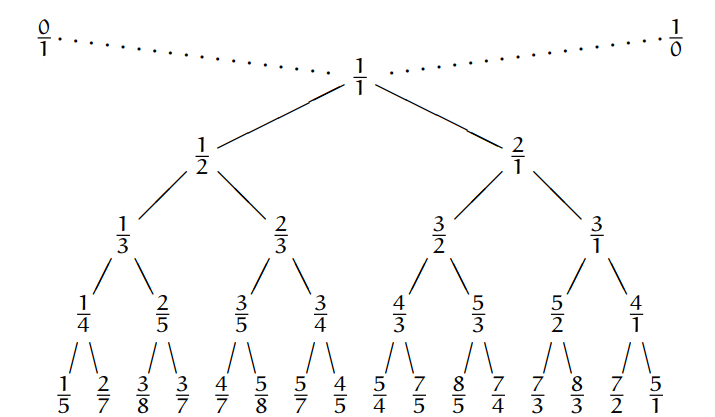
 .
. .
. .
. số hữu tỷ không âm, và hai số cách đều số ở giữa là nghịch đảo của nhau.
 . Tồn tại số tự nhiên
  của
của  sao cho
  . Nếu
. Nếu  , ta thay phân số
  bởi
bởi  ;
;  , ta thay phân số
  bởi
bởi  , suy ra
  bởi hai số hữu tỷ không âm
  với
với  ta sẽ được các dãy mới, gọi là các dãy Stern-Brocot suy rộng. Có thể chứng minh được rằng mọi số hữu tỷ nằm giữa
  đều xuất hiện trong một dãy Stern-Brocot suy rộng nào đó.
 T's Lab